
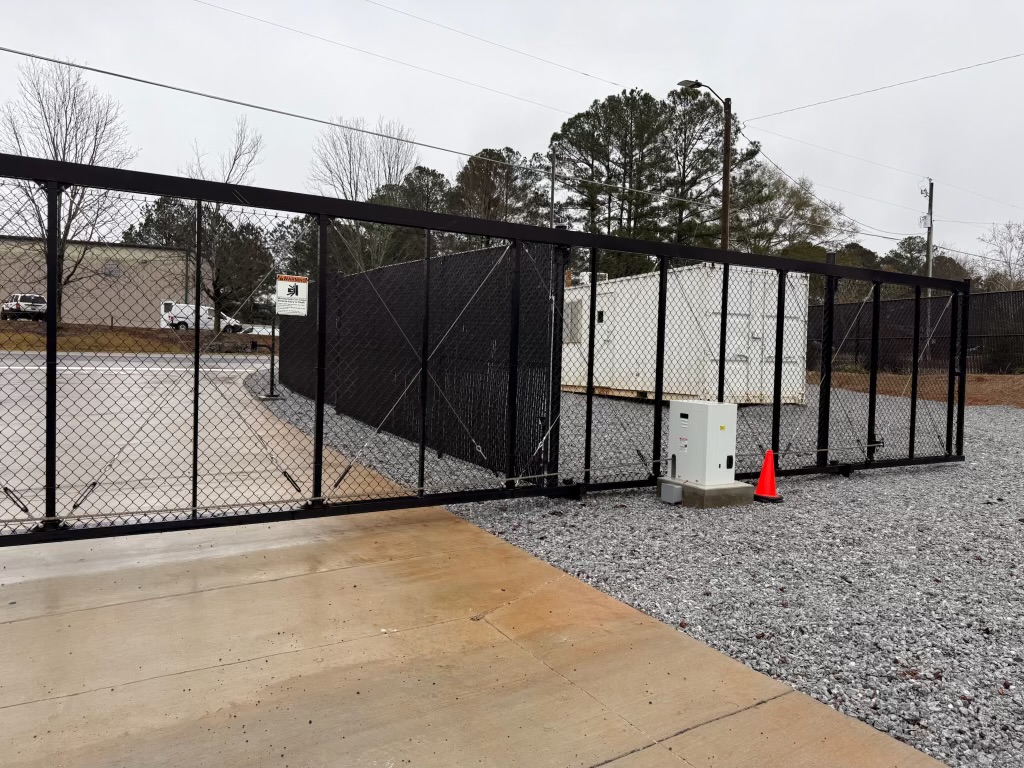
Gate Safety
An automated gate is a powerful moving system. Without proper construction, installation, and safety measures, it can cause serious injury or death. Two nationally recognized standards are central to automated vehicular gate systems: UL 325 for gate operators and their safety systems, and ASTM F2200 for gate construction.
UL 325
Gate Operators and Entrapment Protection
Establishes safety requirements for gate operators and operating systems, including usage classes, entrapment protection, safety device monitoring, controls, and warning signs.
ASTM F2200
Automated Vehicular Gate Construction
Establishes construction requirements for automated vehicular gates, addressing hazards such as openings, pinch points, rollers, support systems, and gate movement.
This Page Is Not a Replacement for the Standards
This page provides general safety education and highlights selected provisions of UL 325 and ASTM F2200. It does not contain every requirement necessary for a compliant installation. Always follow the full published standards, the operator manufacturer's installation instructions and safety requirements, and the requirements of local authorities. If anything on this page differs from those sources, follow the sources.
Why Gate Safety Matters
Automated gates can move without anyone physically controlling them. When safety measures are missing, or equipment is improperly installed or maintained, people can be seriously injured or killed. Children are especially at risk.
Entrapment
A person can be trapped between a moving gate and a wall, fence, or post. Properly selected and installed entrapment protection devices help reduce this risk.
Falling Gates
Gates that are improperly supported or travel beyond their limits can become unstable or fall. Supports, hardware, and positive stops help prevent this.
Pinch Points
Exposed rollers, moving components, and gaps can catch fingers, hands, and feet. Guarding, screening, and proper clearances help close them off.
Children at Play
Children may climb, ride, or play near a gate without recognizing the danger. Controls placed at or near the gate are a common cause of injuries, so user controls must be mounted at least 6 feet away and warnings must be posted.
Gate safety is about protecting people.
Where Each Standard Applies
A typical slide gate installation, showing examples of features addressed by UL 325 and by ASTM F2200.
UL 325 (Operator and Safety Systems)
- 1Listed operator appropriate for the site's usage class
- 2Monitored photo eye and reflector, closing direction (B1)
- 3Monitored photo eye and reflector, opening direction (B1)
- 4Monitored sensing edges, shown on the leading and trailing edges (B2)
- 5Warning signs visible from both sides (street side shown)
- 6Keypad in the approach lane, at least 6 feet away from the gate
ASTM F2200 (Gate Construction)
- 7Gate panel, and fence the gate covers when open, screened to 6 ft above grade or the top of the gate, whichever is less
- 8V-track wheels and other weight-bearing rollers below 8 ft covered or guarded
- 9Positive stops at both ends of travel
- 10Auxiliary supports, including a receiver guide at the receiving post, to help prevent gate fall-over if supporting hardware fails
- 11Latches disabled
- 12Gap at posts no more than 2 1/4 in., unless the post is more than 16 in. away
Illustration for educational purposes only. It shows examples of common safety features, not a complete or certified installation, and not the required number, type, or placement of devices for every gate. Actual device selection and placement depend on site-specific entrapment hazards, the operator's listing, applicable standards, and the manufacturer's installation instructions.
UL 325 Usage Classes
UL 325 classifies vehicular gate operators by intended application. Selecting an operator listed for the site's usage class is an essential part of system design.
Residential
A home of one to four single family dwellings, or a garage or parking area associated with one.
Commercial / General Access
Multifamily housing of five or more units, hotels, retail stores, parking open to the public, or other locations serving the general public.
Industrial / Limited Access
Factories, loading docks, or other locations not accessible by or intended to serve the general public.
Restricted Access
Guarded locations such as airport security areas, where unauthorized access is prevented by security personnel supervision.
The appropriate usage class must be determined from actual site conditions and the operator's listing. Operators listed only for Class III or IV cannot be installed in Class I or II applications.
Understanding Entrapment Protection
An entrapment zone is an area where a person can be trapped between a moving gate and another object. UL 325 requires independent means of entrapment protection, and the same type cannot be used for both means.
Inherent
An entrapment sensing system built into the operator that senses an obstruction, typically through force, speed, or position, and responds according to the operator's design.
Non-Contact Sensor
A photoelectric sensor or equivalent that detects an obstruction in the gate's path without physical contact.
Contact Sensor
A sensing edge or equivalent that responds when contact occurs, installed on gate edges or other locations where contact hazards exist.
Inherent Force Limiting
Inherent force limiting, an inherent adjustable clutch, or an inherent pressure relief device. Permitted only on swing gates and vehicular barrier arms. A clutch or force-limiting feature never counts as entrapment protection on a slide gate operator.
Constant Pressure Control
A control that requires continuous pressure to keep the gate moving, located within sight of the gate. Type D is subject to specific restrictions under UL 325.
Monitored Safety Devices
External photo eyes and sensing edges (Type B1 and B2) must be monitored. The operator verifies at least once per cycle that each required device is present and working. If a device is missing or faulted, the operator runs only in constant pressure mode in that direction. That is why external devices must be models the operator manufacturer lists as compatible.
Minimum protection. UL 325 establishes minimum requirements for independent entrapment protection in each direction of gate travel, as shown in the table below. Two independent means of protection do not necessarily mean two separate external devices. A qualifying inherent (Type A) system may provide one means, and a compatible monitored external device, such as a photo eye or sensing edge, may provide another. The same protection type cannot be counted as both means. The operator manufacturer's listing and installation instructions determine acceptable device combinations, and every entrapment zone must be evaluated, since additional devices may be necessary.
| Gate Type | Opening | Closing |
|---|---|---|
| Horizontal slide | 2 | 2 |
| Horizontal swing | 2* | 2* |
| Vertical pivot | 2 | 2 |
| Vertical lift | 1 | 2 |
* A swing gate requires two independent means in each direction of travel. If there is no entrapment zone in one direction, only one means is required in that direction. The same type of device cannot be used for both means. Barrier arms that never move toward a rigid object within 16 in. and have no pinch points are exempt. Verify against the current edition of UL 325.
What counts as an entrapment zone. On a slide gate, any point up to 6 ft above grade where the moving gate comes within 16 in. of a fixed edge or surface. On a swing gate, any point up to 6 ft above grade where the gap under the gate is between 4 and 16 in., where the hinge center sits more than 4 in. from the end of the post or column, or where the gate comes within 16 in. of a wall, curb, berm, or other fixed object. On a vertical lift gate, any point up to 8 ft above grade with a gap to a fixed object between 4 and 16 in., or less than 16 in. at the bottom. On a vertical pivot gate, gaps to fixed objects between 2 1/4 and 16 in. on the public side, between 4 and 16 in. on the private side, or less than 16 in. at the bottom.
How the operator responds. When an obstruction is sensed or a sensing edge is contacted, the operator must stop and reverse within 2 seconds, in both the opening and closing directions. Repeated obstructions put the operator into a shutdown that requires a reset before normal operation resumes.
Identifying entrapment zones. Hazards vary between installations. A slide gate passing a fence or post creates different hazards than a swing gate opening toward a wall. The type, number, and placement of devices must be determined for the actual installation. Meeting the minimum number of protection means, or installing a particular combination of devices, does not by itself make a system compliant.
Equipment compatibility. Not all monitored safety devices work with every operator. Verify approved devices, wiring, and mounting locations in the operator manufacturer's instructions.
Never bypass, disconnect, or defeat a required safety device to restore gate operation.
Gate Safety Warning Signs
UL 325 requires a minimum of two warning signs in the area of the gate, each visible to people on its side of the gate. Follow the operator manufacturer's instructions for the required signs and their placement.
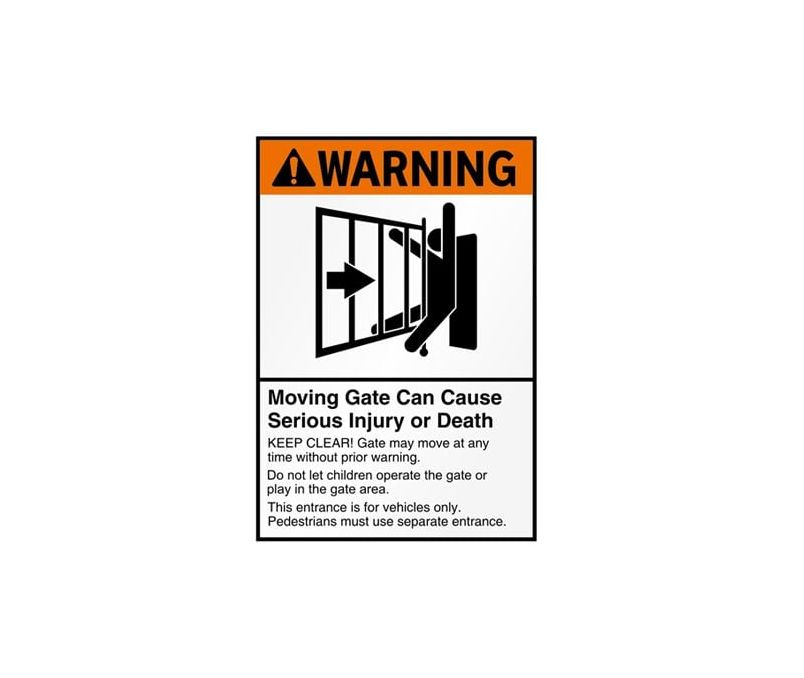
Common Warnings
- A moving gate can cause serious injury or death.
- Keep clear of the gate while it is moving.
- Do not let children operate or play near the gate.
- The entrance is for vehicles only, and pedestrians must use a separate entrance.
Example of an automated vehicular gate warning sign. View this sign.
ASTM F2200: Gate Construction
A listed operator is only one part of a safe system. ASTM F2200 applies to any new gate built to be automated, any manual gate being automated, and any automated gate whose operator or gate panel is replaced. It does not apply to pedestrian gates or gates that will never be automated.
Fall Over Protection
Gate systems must have auxiliary supports that prevent the gate from falling over more than 45 degrees from vertical if it becomes detached from its supporting hardware. This applies to all gate types. The design of the supports depends on the gate and its construction; no single support design is required for every gate.
Screened Openings
On slide gates, openings must prevent a 2 1/4 in. sphere from passing through, from the bottom of the gate up to 6 ft above grade or the top of the gate, whichever is less. This applies to the entire moving gate panel, including its back frame, and to the portion of adjacent fence the gate covers when open.
Gaps at Posts
On slide gates, the gap between the gate and a fixed object nearest the roadway, such as a post, must not exceed 2 1/4 in. unless the object is more than 16 in. from the gate frame.
Covered Wheels and Rollers
Weight-bearing rollers, including V-track wheels and exposed cantilever rollers, must be covered or guarded unless they are 8 ft or more above the ground. Enclosed-track cantilever gates, which run on trucks inside a channel, do not need separate guards.
Positive Stops
Positive stops are required to limit travel to the fully open and fully closed positions, helping prevent the gate from disengaging from its supporting hardware.
Gate Latches
Gate latches must be disabled on an automated gate.
Balance and Movement
The gate must be balanced so it does not open or close on its own when disconnected from the operator. UL 325 installation instructions also call for the gate to move freely before the operator is installed, so damage, binding, or misalignment must be corrected first.
Swing Gate Clearances
There must be no entrapment zone between the gate and its post, column, or wall as it opens. The distance from the center hinge point to the edge of the supporting column, pillar, or wall must be less than 4 in., or the area must be provided with appropriate entrapment protection. Except for the hinge area, the distance between the gate in its fully open position and a fixed object must be greater than 16 in., or appropriate entrapment protection must be provided. No pickets are allowed below the bottom rail, and other bottom protrusions may not exceed 1/2 in.
Separate Pedestrian Access
Automated vehicular gates are for vehicles only. A separate pedestrian entrance must be provided, located away from the moving gate. UL 325 installation instructions also prohibit building a pedestrian gate into the vehicular gate panel.
Protrusions
No protrusion greater than 1/2 in. is allowed on the bottom or vertical edges of the gate, and no protrusion of any length may have sharp edges. Exceptions include top pickets and decorations in line with the gate, locks, wheels, and positive stops.
Barbed Wire and Tape
Barbed wire on a gate panel must be at least 6 ft above grade, and barbed tape at least 8 ft above grade.
Receiver Guides
Slide gates must be stable enough to enter the receiver guide properly. Single panel receiver guides must be recessed behind the leading edge of the receiver post unless they are 8 ft or more above ground. Receiver guides on bi-parting slide gates need a leading edge of at least 9 sq. in.
Other Gate Types
Vertical Lift Gates
Openings must prevent a 4 in. sphere from passing through, and no gap in the gate frame may exceed 4 in. Framing must be smooth, and positive stops are required.
Vertical Pivot Gates
Areas that pass a fixed object, from the bottom to the top of the gate or 72 in. above grade, whichever is less, must prevent a 2 1/4 in. sphere from passing through. No frame gap may exceed 2 1/4 in., framing must be smooth, and the gate must be stable enough to enter its receiver guide.
Overhead Pivot Gates
Rollers below 8 ft must be guarded. Openings must prevent a 4 in. sphere from passing through, and no gap between the gate frame and a fixed object may exceed 2 1/4 in. Framing must be smooth, positive stops are required, and the counterbalance must support the gate in any position.
Horizontal Bifold Gates
Horizontal bifold gates have unique movement patterns and potential hazards associated with their folding sections, hinges, and nearby fixed objects. Gate construction, clearances, and protective measures must be evaluated using the applicable provisions of ASTM F2200 and the operator manufacturer's instructions.
Class IV gates are designed and installed to the security requirements of the specific site. The dimensions and construction considerations summarized on this page are provided for general educational purposes. Requirements may vary by gate type, usage class, and applicable standard. Always verify measurements and installation requirements against the current published edition of ASTM F2200.
Key Safety Considerations for Installers
These reminders highlight common areas to evaluate when installing or servicing automated vehicular gates. This is an educational reference, not a complete installation checklist or a compliance inspection.
- Follow the operator manufacturer's installation instructions and safety requirements.
- Select an operator listed for the site's usage class and suited to the gate's type, construction, size, and weight.
- Confirm the gate moves freely in both directions before installing the operator. Never over-tighten the clutch or pressure relief to make up for a damaged or poorly working gate.
- Evaluate entrapment zones along the gate's entire path of travel and provide the required independent entrapment protection for each.
- Verify that monitored photo eyes, sensing edges, and other devices are approved by the operator manufacturer.
- Eliminate or guard exposed pinch points, rollers, and hazardous openings, and check clearances to fixed objects.
- Verify that auxiliary supports, positive stops, and other safeguards are in place, and that latches are disabled.
- Mount user controls, such as keypads, at least 6 feet away from the gate, where the user cannot reach over, under, around, or through it. Emergency controls accessible only to fire, police, or EMS may be placed anywhere in line of sight of the gate.
- Place stop and reset controls in line of sight of the gate. Pressing reset must not start the operator.
- On Type D (constant pressure) systems, give the user a full view of the gate, post a placard next to the controls, and do not connect an automatic closing device or other activation device.
- On Class I and II sites, slide gates may not travel faster than 1 ft per second.
- Provide a separate pedestrian entrance located so pedestrians cannot contact the moving vehicular gate.
- Make sure swing gates do not open into public access areas.
- Install the warning signs required by the standard and the operator instructions, and photograph them for the job file.
- Confirm emergency access requirements with the local fire department, and install the required responder access device.
- For gates controlling access from roads open to public travel, follow the MUTCD marking requirements for gate arms and sliding sections.
- Call 811 before digging.
- Test the operator and every safety device using the manufacturer's procedures.
- Give the property owner the manufacturer's safety information, operating instructions, and maintenance recommendations.
- Never omit or disable a safety device at the owner's request. A waiver does not make an unsafe system acceptable.
- If you find a gate that does not meet ASTM F2200, notify the customer in writing and correct it before servicing.
- Correct any safety deficiency before placing the gate into service.
Important: This list does not establish or confirm compliance with UL 325, ASTM F2200, or any code. Installers must consult the published standards, the manufacturer's instructions, and the applicable authorities.
Emergency Access
Fire, police, and EMS must be able to get through an automated gate quickly. Emergency access requirements depend on your municipality, so contact your local fire department or fire marshal before designing or installing a gate system.
Responder Access Devices
Jurisdictions may require a specific device for responders, such as a key switch or lock box, a siren-activated sensor, or a radio or strobe-activated receiver. Which one depends on what local responders use.
Power Failure Operation
Local rules may set how the gate must behave during a power outage, such as opening automatically, running on battery backup, or providing a manual release. An open-on-power-loss kit leaves the site unsecured until power returns, so review security needs first.
Manual Release
Responders may need a way to open the gate if the operator fails. Location and access to the release may be specified by the fire department.
Approval and Inspection
Some jurisdictions require plan review, permits, or a fire department inspection before an automated gate is placed into service.
Requirements vary by municipality. What is accepted in one city or county may not be accepted in the next, and a generic key box may not satisfy local code. Ask the fire department what primary device is required, whether a backup is required, whether entry and exit gates must both open, and whether one override serves fire, EMS, and police. Confirm the required access method before ordering equipment. UL 325 allows emergency access controls used only by authorized personnel, such as fire, police, or EMS, to be located anywhere in line of sight of the gate.
Frequently Asked Questions
Are UL 325 and ASTM F2200 required by law?
No federal law requires either standard on its own. Both are referenced in model codes, including the International Building Code and International Fire Code (2009 and later editions) and the International Residential Code (2012 and later editions). Where a jurisdiction adopts those codes, compliance becomes a legal requirement, and adopted code overrides contracts and specifications. Some states add their own rules. For example, Louisiana requires a license to install or service automated gate systems. Contact the local building department, fire marshal, or other authority having jurisdiction before designing or installing a system.
If an operator is UL 325 listed, is the installation compliant?
No. An operator's listing does not establish compliance for the completed installation. Gate construction, supporting hardware, entrapment protection, controls, and site conditions must also meet the applicable requirements.
What does "listed to UL 325" mean?
A listed operator has been tested and certified to UL 325 by a recognized testing laboratory, such as UL, Intertek (ETL), or CSA. Look for the listing mark on the operator label. "UL approved" is not the correct term, and a manufacturer's claim that an operator is "compliant" is not the same as a listing. For a listed operator, the installation manual's instructions are requirements.
Can I bypass a monitored photo eye or edge sensor?
No. Required entrapment protection devices must never be bypassed or defeated. Doing so can expose people to serious injury or death. If a device is malfunctioning, follow the operator manufacturer's troubleshooting instructions or contact qualified technical support.
Can a property owner decline safety devices?
No. Required entrapment protection is not optional, and a signed waiver does not make an unsafe system acceptable. Installers should not omit or disable safety devices at an owner's request.
Are vehicle detection loops safety devices?
No. UL 325 addresses entrapment protection for people. Vehicle loops detect vehicles and help control gate operation, but they do not count as entrapment protection under UL 325.
Does UL 325 apply to residential gates?
Yes. UL 325 applies to all usage classes, including Class I residential gate operators. Entrapment protection and the other safety requirements apply to residential installations.
Does an older gate need to meet current requirements when an operator is replaced?
Yes. ASTM F2200 applies when an operator or gate panel is replaced, and when a manual gate is automated. Bring the gate and its safety systems up to current requirements, following the replacement operator's instructions and local codes, before returning it to service.
Who is responsible for gate safety after installation?
Responsibilities depend on applicable laws, contracts, and circumstances. Property owners should arrange regular maintenance and inspections, keep warning signs in place, and have malfunctioning safety equipment repaired promptly. Installers and service providers should follow the applicable standards and manufacturer instructions.
Where can I find the complete standards?
UL 325 is available from UL Standards & Engagement and ASTM F2200 from ASTM International. Professional training and certification are available through the American Fence Association, including its Gate Automation Installation School and CGAT credential, the Institute of Door Dealer Education and Accreditation (IDEA), and Fence University at The Fence Show. Additional gate safety resources are available at GateSafety.com. See Get Trained on Automated Gate Safety below.
Get Trained on Automated Gate Safety
Professional training and certification in gate automation are available through several industry organizations.
AFA Gate Automation Installation School
Improper installation of gate systems can be dangerous and even deadly. The American Fence Association's Gate Automation Installation School (GAIS) trains installers to understand and apply safety standards that protect homeowners, businesses, and the public. It is offered annually at AFA University.
What You'll Learn
- Proper design and installation of gate operator systems
- Safety standards and compliance requirements
- Hands-on installation guided by experts
- Troubleshooting and real-world problem solving
Who Should Attend
- Installers and technicians responsible for automated gate systems
- Contractors expanding into gate automation
- Anyone seeking credibility and skill in gate installation
Certification Option
The school supports preparation for the Certified Gate Automation Technician (CGAT) credential. Certification is optional and requires a separate application and fee, with the option to take the exam at the end of the school.
IDEA Master Technician Bundle
The Institute of Door Dealer Education and Accreditation offers the Automated Gate Systems Master Technician Bundle, four certifications earned in sequence through one application:
- Automated Gate Operator Installer
- Automated Gate Systems Technician Level 1
- Automated Gate Systems Technician Level 2
- Automated Gate Systems Technician Level 3
Each certification has its own exam. Candidates who complete all four earn the Automated Gate Systems Master Technician designation.
View IDEA CertificationsFence University Gate Operator Certification
A two-day, industry-recognized certification program covering gate safety, wiring, troubleshooting, and best practices, offered through Fence University at The Fence Show. Check the show schedule for current dates.
Fence University also provides gate safety information and resources at GateSafety.com.
Sources and Additional Resources
- UL 325, Standard for Door, Drapery, Gate, Louver, and Window Operators and Systems. UL Standards & Engagement. shopulstandards.com
- ASTM F2200, Standard Specification for Automated Vehicular Gate Construction. ASTM International. astm.org
- American Fence Association, AFA University, Gate Automation Installation School, and Certified Gate Automation Technician (CGAT) credential. americanfenceassociation.com
- Door & Access Systems Manufacturers Association (DASMA), automated gate safety publications. dasma.com
- Institute of Door Dealer Education and Accreditation (IDEA), gate automation certifications. dooreducation.com
- Fence University, installer education and gate operator certification. fenceuniversity.com
- GateSafety.com, gate safety information and resources. gatesafety.com
- Gate operator manufacturer installation instructions, technical bulletins, and safety requirements.
For current requirements, consult the applicable published editions of UL 325 and ASTM F2200, manufacturer installation instructions, and authorities having jurisdiction.
Important Safety Information and Disclaimer
The information on this page is intended for general educational and safety awareness purposes only. It summarizes selected considerations associated with UL 325 and ASTM F2200 and is not a complete interpretation of either standard. It is not a substitute for professional training, engineering, installation instructions, or applicable laws and codes.
Safety standards, equipment requirements, and local regulations may change. The applicable published standards, manufacturer instructions, and requirements of authorities having jurisdiction must be consulted when evaluating an installation.
Southeast Access Technologies, Inc. is a distributor of gate automation and access control products. We do not design, install, inspect, approve, or certify automated gate systems. Providing products, product recommendations, educational resources, or general technical information does not constitute an evaluation or certification of any installation and does not establish installation compliance. Southeast Access Technologies, Inc. does not represent or warrant that the information on this page is complete or sufficient to establish compliance for any application.
Responsibilities for the design, installation, inspection, operation, and maintenance of automated gate systems depend on applicable laws, contracts, and individual circumstances. Installers and other responsible parties must consult the applicable standards, manufacturer instructions, and local requirements. Automated gate systems should be installed and serviced by qualified personnel.
Page reviewed: October 2026.
At Southeast Access Technologies, we believe safety should always come first. No installation, product, or shortcut is worth putting someone's life at risk.
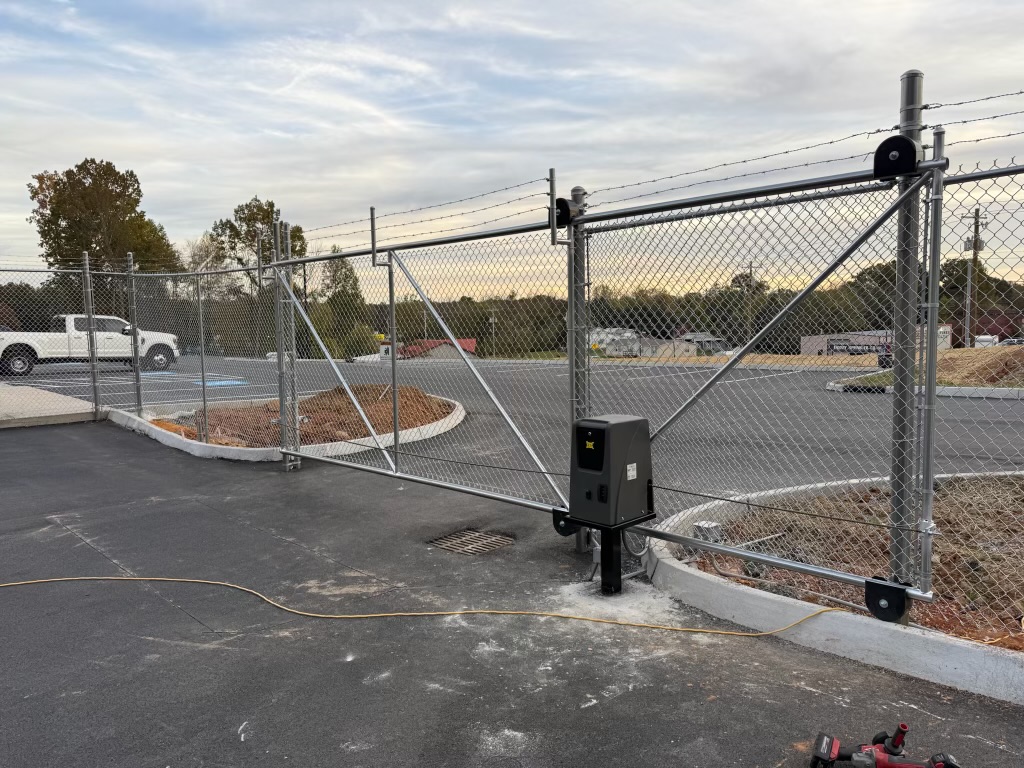
Need Safety Devices or Technical Resources?
We supply monitored photo eyes, sensing edges, warning signs, and related accessories from the manufacturers we carry, and can help you locate manufacturer technical resources.
Product recommendations and general information do not replace site-specific hazard evaluations, manufacturer installation instructions, or applicable safety requirements.
Shop Safety Devices Contact Sales Manufacturer Tech Support